








 |
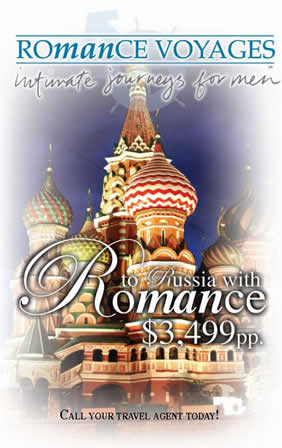
 ROmance VOYAGES begins your journey in Moscow touring Red Square, St.Basel's, the Armory Museum, and the Arbat shopping district for a stroll through Gum, Russia's largest department store. Travel on to Tver, the ancient trading post located at the confluence of the Volga and Tversta rivers and home to Putevoy Dvorets, Catherine the Great's resting spot on her journeys from Moscow to St.Petersburg. ROmance VOYAGES begins your journey in Moscow touring Red Square, St.Basel's, the Armory Museum, and the Arbat shopping district for a stroll through Gum, Russia's largest department store. Travel on to Tver, the ancient trading post located at the confluence of the Volga and Tversta rivers and home to Putevoy Dvorets, Catherine the Great's resting spot on her journeys from Moscow to St.Petersburg.
Next is Novgorod, the ancient capital of Russia famous for the Novgorod Kremlin and St.Sophia Cathedral. Spend three days and two nights in imperial St.Petersburg for an in-depth look at this 18th C bastion of Romanoff excess. Tours include Peterhof, the grand palace and gardens, the Hermitage, Peter and Paul Fortress and St.Isaacs, just to name a few.
Hotels include the 5-star Marriott Grand in Moscow, the Beresta Palace in Novgorod, and the Sokos Olympic Garden in St.Petersburg. Land package includes hotel, airport and intra-Russia transfers, all sightseeing entrance fees, and most meals.
Itinerary
Day 1 (0) - May 1, Saturday
USA/Moscow
Depart USA
Meal:
Day 2 (1) - May 2, Sunday
Moscow
  Arrive and check into Marriott Grand, Welcome Dinner.
Meal: D
Arrive and check into Marriott Grand. Join us for a Welcome dinner in Russkiy Pogrebok, the Marriott's fine Russian restaurant for an authentic Russian meal.
Day 3 (2) - May 3, Monday
Moscow
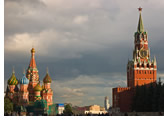 Explore Moscow with a half-day city tour and optional evening Subway tour. Explore Moscow with a half-day city tour and optional evening Subway tour.
Meal: B
Explore Moscow with a half-day city tour after breakfast. Moscow is one of the largest cities in the world and the heart and soul of Russia.
We will see the highlights of this vast city starting with the Kremlin, the historic fortress complex overlooking the Moskva River. It is home to four palaces and four cathedrals. The massive Kremlin Walls, capped with 20 towers, were built by Italian masters from 1485 to 1495. The complex serves as the official residence of the President of Russia.
Within the Kremlin we find Red Square and the famed Cathedral of Intercession of the Virgin on the Moat (better know as Saint Basil’s) and its Disney-esque onion domes. Built by Ivan the Terrible between 1555 and 1561, this is by far the most enduring and recognizable building in Russia. We will also visit the Armory Museum home to Moscow's oldest and most prestigious collection of Tsarist artifacts, Russian and foreign jewelry, and armor. Later on we will pass Moscow University founded in 1755 and is reportedly the tallest educational building in the world. Next stop is the Arbat shopping district and a stroll through GUM, Russia's grandest department store. Enjoy the balance of your day at leisure.
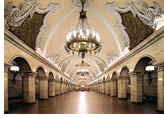 We will offer an optional evening tour: Moscow by Night and a Moscow Subway tour. Moscow's subway is known as the "the people's palaces". Stalin was the force behind creating this elegant system. Every station is elegantly designed using expensive marble, mosaics, classic sculptures and extravagant chandeliers. These metro stations were supposed to display the best of Soviet architecture and design and show how privileged the lifestyle of the Russian people had despite the fact that they were built by forced laborers. (Pricing and schedule TBA) Breakfast is included today. We will offer an optional evening tour: Moscow by Night and a Moscow Subway tour. Moscow's subway is known as the "the people's palaces". Stalin was the force behind creating this elegant system. Every station is elegantly designed using expensive marble, mosaics, classic sculptures and extravagant chandeliers. These metro stations were supposed to display the best of Soviet architecture and design and show how privileged the lifestyle of the Russian people had despite the fact that they were built by forced laborers. (Pricing and schedule TBA) Breakfast is included today.
Day 4 (3) - May 4, Tuesday
Moscow / Tver / Novgorod
After breakfast transfer via coach to Tver. We will have a city tour then it is on to Novgorod. Group dinner in Novgorod tonight.
Meal: B, D
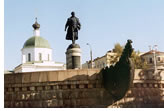 After breakfast we transfer via coach to Tver. Tver is about 100 miles from Moscow and dates back to the 13th C when royals began settling the area. As a trading port on the Volga, it quickly grew wealthy and for a while, competed with Moscow as Russia's premier city. In the end, Moscow won and Tver began to decline. After breakfast we transfer via coach to Tver. Tver is about 100 miles from Moscow and dates back to the 13th C when royals began settling the area. As a trading port on the Volga, it quickly grew wealthy and for a while, competed with Moscow as Russia's premier city. In the end, Moscow won and Tver began to decline.
With the foundation of St. Petersburg in the 18th C, Tver regained importance as a principal station on the highway between Moscow to St. Petersburg. Russian royalty and nobility traveling between the new and old capitals found it a convenient place to rest. It is about 100 miles from Moscow and 370 miles from St. Petersburg. Of note is Putevoy Dvorets or the "Traveling Palace" commissioned by Catherine the Great as a place to rest on her journeys between Moscow and St. Petersburg. Built in 1775, the structure is one of Tver's most imposing landmarks. It is decorated in royal style, its18th C interiors and furnishings showcase the excessive tastes of the Empress of Russia. Today it houses the city's Art Gallery with a collection of Russian and Western European works.
After our city tour we travel on to Novgorod and check in to the Beresta Palace for the night. We will enjoy a group dinner tonight. Breakfast and dinner are included today.
Day 5 (4) - May 5, Wednesday
Novgorod/ St. Petersburg
Ater breakfast enjoy a morning tour of Novgorod including the Kremlin, St. Sophia Cathedral and the Yarslov Court. This afternoon we travel to St. Petersburg, the former capital of the Romanov Csars. Sightseeing will include Peter and Paul Fortress, the Cathedral, and St. Issac's. Afterwards, we return to our hotel and dinner.
Meal: B, D
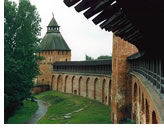 After breakfast enjoy a morning tour of Novgorod including the Novgorod Kremlin, St. Sophia Cathedral and the Yarslov Court. After breakfast enjoy a morning tour of Novgorod including the Novgorod Kremlin, St. Sophia Cathedral and the Yarslov Court.
The Novgorod Kremlin, known for centuries as the Detinets, is a brick fortress with 9 towers. The first walls of the Detinets were built in the 10th century, but the walls have been rebuilt many times. The brick walls we see were constructed in the 14th C and still stand strong. The Detinets contains the oldest palace in Russia, the Chamber of the Facets built in 1433. It served as the main hall for the archbishops. It also contains the oldest Russian bell tower and the oldest Russian clock tower built in 1673.
The other significant monument in the Kremlin is the 1862 bronze monument to the Millennium of Russia, representing the most important figures from the country's history including composer Mikhail Glinka, writers Alexander Pushkin and Mikhail Lomonosov, and painter Karl Briullov.
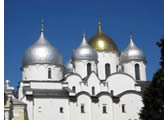 St. Sophia Cathedral is five-domed, stone cathedral built by Vladimir of Novgorod between 1045 and 1050 with an eclectic mix of Byzantine and Romanesque styles. The cathedral is austere, with little interior or exterior adornment and very narrow windows. The church is painted simply with white paint and is topped with a Gold dome surrounded by four silver domes. St. Sophia Cathedral is five-domed, stone cathedral built by Vladimir of Novgorod between 1045 and 1050 with an eclectic mix of Byzantine and Romanesque styles. The cathedral is austere, with little interior or exterior adornment and very narrow windows. The church is painted simply with white paint and is topped with a Gold dome surrounded by four silver domes.
The cathedral has three entrances, the doors are all cast bronze and decorated with reliefs depicting biblical and evangelical scenes: the12th century Sigtuna Gate also known as the Magdeburg gate, and the Plock gate plus the Korsun and Vasilii gates. These are superb examples of medieval European bronze casting.
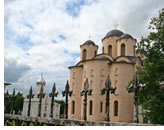 Yaroslav's court was the economical and political center of the ancient town of Novgorod. It is named after the palace of Yaroslav, which is situated here. Close to Yaroslav's Court, is a territory called "Torg", where the merchants from all over Europe conducted business. This open-air architectural-ethnographic museum "Vitoslavlitsy" shows us a whole complex of genuine wooden and architecture, including ancient churches of the 16th - 18th centuries and peasant houses of the 19th - early 20th centuries, exhibitions of folk art and everyday household items used by the Novgorod peasants. Yaroslav's court was the economical and political center of the ancient town of Novgorod. It is named after the palace of Yaroslav, which is situated here. Close to Yaroslav's Court, is a territory called "Torg", where the merchants from all over Europe conducted business. This open-air architectural-ethnographic museum "Vitoslavlitsy" shows us a whole complex of genuine wooden and architecture, including ancient churches of the 16th - 18th centuries and peasant houses of the 19th - early 20th centuries, exhibitions of folk art and everyday household items used by the Novgorod peasants.
After our tour of Novgorod, we will travel to St. Petersburg, the former capital of the Romanov Tsars. Once in St. Petersburg, we will begin with a city tour starting with a visit to the Peter and Paul Fortress. The Fortress, the first structure built in St. Petersburg, is the original citadel of the city founded by Peter the Great in 1703. As a true military structure, it is located on a small island in the Neva delta. It was designed and built by Swiss-Italian architect Domenico Trezzini between 1706 and 1740 to protect the new city from invading Swedes.
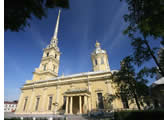 In the middle of the fortress stands the Peter and Paul Cathedral also designed and built by Trezzini. The cathedral's crypts hold the remains of all the Russian Emperors and Empresses from Peter the Great to Alexander III. Built between 1712 and 1733 the Cathedral was the first church in the city to be built of stone. The spire is 404 feet tall (it is the tallest building in town) and topped with a golden angel holding a cross. It is the most important symbol of St Petersburg. In the middle of the fortress stands the Peter and Paul Cathedral also designed and built by Trezzini. The cathedral's crypts hold the remains of all the Russian Emperors and Empresses from Peter the Great to Alexander III. Built between 1712 and 1733 the Cathedral was the first church in the city to be built of stone. The spire is 404 feet tall (it is the tallest building in town) and topped with a golden angel holding a cross. It is the most important symbol of St Petersburg.
After touring the fortress and the Cathedral, we are off to St. Isaac's Cathedral. The neoclassical structure we see today is the 4th incarnation and took 40 years (1818-1858) to construct under the design and direction of Frenchman Auguste de Montferrand. The exterior is faced with gray and pink stone. Decorated with112 red granite columns with Corinthian capitals, each hewn out of a single piece of stone, there are 48 on the ground level, 24 on the rotunda of the uppermost dome, 8 on each of four side domes, and 2 framing each of four windows. Lastly, 24 statues gaze down from the roof and another 24 from the top of the rotunda.
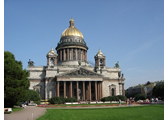 This stunning but somber exterior belies the extravagant interior of St. Isaacs. The cathedral's bronze doors are covered in reliefs modeled after the famous Baptistry doors in Florence, Italy. The dome is covered in gold gilding. The technique used is similar to spray painting but used a mercury solution to make them gold "flow". Since face masks were non-existent, the spray vapors were easily inhaled and killed an unknown number of workers via mercury poisoning. There are also more than a dozen golden statues of angels around the interior of the rotunda. Another cutting edge technology of the day was used to create these angels. Using the then modern galvanoplastic technology they are pure gold but only a few millimeters thick thus very lightweight. This is the first recorded use of this technique for building purposes. This stunning but somber exterior belies the extravagant interior of St. Isaacs. The cathedral's bronze doors are covered in reliefs modeled after the famous Baptistry doors in Florence, Italy. The dome is covered in gold gilding. The technique used is similar to spray painting but used a mercury solution to make them gold "flow". Since face masks were non-existent, the spray vapors were easily inhaled and killed an unknown number of workers via mercury poisoning. There are also more than a dozen golden statues of angels around the interior of the rotunda. Another cutting edge technology of the day was used to create these angels. Using the then modern galvanoplastic technology they are pure gold but only a few millimeters thick thus very lightweight. This is the first recorded use of this technique for building purposes.
Other decorations made from marble and granite from all over Russia include grand columns and pilasters, intricately inlayed floors, and a life-sized statue of Montferrand. The iconostasis (a wall of icons used as a screen between the altar and the nave of a church) is framed by eight columns of semiprecious stone including deep green malachite and vivid blue lazurite. The ceilings and walls were originally adorned with oil on canvas paintings by noted Russian artist Karl Pavlovich Briullov. The originals decayed due to the cold damp atmosphere so they were reproduced as mosaics but many have never been completed.
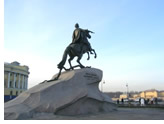 In front of St. Isaac's stands the Bronze Horseman, the great statue of Peter the Great sitting heroically on his horse, his outstretched arm pointing towards the River Neva to the west. Commissioned by Catherine the Great and sculpted by Etienne Falconet the monument was finished in 1782. The statue is 20 feet tall and sits on a 25 foot tall pedestal called the Thunder Stone. At 1653 tons, it is said to be the largest stone ever moved by man. It was move 4 miles to the Gulf of Finland then set on a barge supported by two warships and floated up the Neva River before resting in the square. It took 400 men 9 months to move the stone using an ingenious ball bearing technique to drag the stone over the frozen ground. In front of St. Isaac's stands the Bronze Horseman, the great statue of Peter the Great sitting heroically on his horse, his outstretched arm pointing towards the River Neva to the west. Commissioned by Catherine the Great and sculpted by Etienne Falconet the monument was finished in 1782. The statue is 20 feet tall and sits on a 25 foot tall pedestal called the Thunder Stone. At 1653 tons, it is said to be the largest stone ever moved by man. It was move 4 miles to the Gulf of Finland then set on a barge supported by two warships and floated up the Neva River before resting in the square. It took 400 men 9 months to move the stone using an ingenious ball bearing technique to drag the stone over the frozen ground.
After a long day of touring we retire to the Sokos Olympic Garden Hotel for another group dinner and a good night's sleep. Breakfast and dinner are included today.
Day 6 (5) - May 6, Thursday
St. Petersburg
When Peter the Great founded St. Petersburg in 1703, he hired Europe's best architects, craftsmen, and artist to build and decorate every inch of the city. Today's sightseeing will takes us to the Hermitage which houses over 3 million works of art. The balance of the day will be at your leisure.
Meal: B
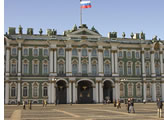 When Peter the Great founded St. Petersburg in 1703, he hired Europe's best architects, artists, and craftsmen to build and decorate every inch of the city. When Peter the Great founded St. Petersburg in 1703, he hired Europe's best architects, artists, and craftsmen to build and decorate every inch of the city.
Today's sightseeing will takes us to the Hermitage. Founded in 1764 by Catherine the Great, it is one of the largest and oldest museums in the world. The collections open to the public are just a small part of over 3 million works of art and artifacts in the overall collection. The Hermitage also owns the largest collections of paintings in the world.
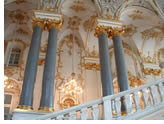 The Museum is housed in six historic buildings along Palace Embankment, fronting the Neva River. The street was laid out between 1763 and 1767, as the premier spot for the lavish homes of the Russian Nobility. The buildings including the Winter Palace, the Tsar’s residence from 1732 to 1917, the Menshikov Palace, built by Italian architect Giovanni Mario Fontana in 1710 as a residence of Saint Petersburg Governor General Alexander Menshikov, the Museum of Porcelain, a Storage Facility at Staraya Derevnya, and large portion of General Staff Building. The buildings are as impressive as the collections. The Museum is housed in six historic buildings along Palace Embankment, fronting the Neva River. The street was laid out between 1763 and 1767, as the premier spot for the lavish homes of the Russian Nobility. The buildings including the Winter Palace, the Tsar’s residence from 1732 to 1917, the Menshikov Palace, built by Italian architect Giovanni Mario Fontana in 1710 as a residence of Saint Petersburg Governor General Alexander Menshikov, the Museum of Porcelain, a Storage Facility at Staraya Derevnya, and large portion of General Staff Building. The buildings are as impressive as the collections.
After our museum tour, we will have the balance of the day at leisure to explore St. Petersburg. Breakfast is included today. Lunch and dinner are on your own.
Day 7 (6) - May 7, Friday
St.Petersburg
Today we tour Petrodvorets (Peterhof), the summer residence of Czar Peter the Great. It rivals Versailles with its palaces, extensive gardens, terraces of gilded statues and fountain cascades on the Gulf of Finland. Enjoy the elegant atmosphere of these baroque gardens and palaces. The rest of the afternoon is free. Tonight we attend one of the best Russian Folklore programs in St. Petersburg. See authentic dance, music, and costumes from around Russia. During the intermission canapes, Russian champagne and vodka can be sampled. This is truly a memorable experience!!!
Meal: B
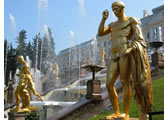 Today we tour Petrodvorets (Peterhof), the summer residence of Tsar Peter the Great. This is the absolute highlight of your tour of Russia. It is impossible to put in just a few paragraphs, the amazing beauty of this place. It rivals Versailles with its palaces, extensive gardens, terraces of gilded statues, numerous fountains and cascades, and a reflecting canal running all the way to the Gulf of Finland. Today we tour Petrodvorets (Peterhof), the summer residence of Tsar Peter the Great. This is the absolute highlight of your tour of Russia. It is impossible to put in just a few paragraphs, the amazing beauty of this place. It rivals Versailles with its palaces, extensive gardens, terraces of gilded statues, numerous fountains and cascades, and a reflecting canal running all the way to the Gulf of Finland.
Begin with the Grand Palace itself. As you approach the palace, you are met with acres of finely manicured parterre gardens and a huge reflecting pond and fountain. This area is known as the Upper Garden or Upper Park depending on who you ask. In the distance, facing south, lies the front of the vast yellow and white baroque palace. Approaching the palace the ground is flat and level but the palace actually sits on a bluff 50 feet above the surrounding land to the back of the palace and commands a fantastic view of the gulf to the north.
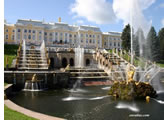 As the bluff drops away Peter and his architects took full advantage of the topography to create the Grand Cascade that dominates the hillside. Banks of fountains, pools, basins and gilded statuary flank a two-story grotto. This grand waterfall leads you to the pool of the Samson Fountain, at the lower end of the slope. This area is known as the Lower Garden or Lower Park. The massive gilded Samson Fountain was placed in this pool in the 1730s. It depicts Samson tearing open the jaws of a lion. This is said to represent Russia's victory over the Swedes during the Great Northern War. A 65 foot vertical jet of water shoots from the mouth and is the highest on the estate. The original Samson was lost during WWII. The statue we will see is a copy brought to the garden in 1947. At the outbreak of WWII, the local workers attempted to hide many of the palace treasures and fountains, but time ran out too fast. The palace and grounds were captured by German forces in 1941 and were occupied until 1944. During this time much of the palace was bombed and burned, the gardens destroyed, and most of the fountains were lost. Immediately after the war, painstaking and careful restoration began and is still in progress almost 60 years later. The palace and gardens also underwent an amazing facelift for its 300th anniversary in 2003. As the bluff drops away Peter and his architects took full advantage of the topography to create the Grand Cascade that dominates the hillside. Banks of fountains, pools, basins and gilded statuary flank a two-story grotto. This grand waterfall leads you to the pool of the Samson Fountain, at the lower end of the slope. This area is known as the Lower Garden or Lower Park. The massive gilded Samson Fountain was placed in this pool in the 1730s. It depicts Samson tearing open the jaws of a lion. This is said to represent Russia's victory over the Swedes during the Great Northern War. A 65 foot vertical jet of water shoots from the mouth and is the highest on the estate. The original Samson was lost during WWII. The statue we will see is a copy brought to the garden in 1947. At the outbreak of WWII, the local workers attempted to hide many of the palace treasures and fountains, but time ran out too fast. The palace and grounds were captured by German forces in 1941 and were occupied until 1944. During this time much of the palace was bombed and burned, the gardens destroyed, and most of the fountains were lost. Immediately after the war, painstaking and careful restoration began and is still in progress almost 60 years later. The palace and gardens also underwent an amazing facelift for its 300th anniversary in 2003.
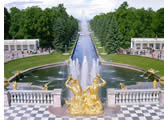 The rest of the afternoon is free. Be sure to walk the grounds. The Lower Garden to the east and west include the Italian Fountain, the French Fountain, the Checkerboard Cascade, the Orangerie and Triton fountain, the fountains of Adam and Eve, the Roman fountain, the Hermitage Palace, the Lion Cascade, and the Golden Hill Cascade. Enjoy a nice lunch right in the Lower Gardens at The Great Greenhouse, located in the original greenhouse of the estate. The rest of the afternoon is free. Be sure to walk the grounds. The Lower Garden to the east and west include the Italian Fountain, the French Fountain, the Checkerboard Cascade, the Orangerie and Triton fountain, the fountains of Adam and Eve, the Roman fountain, the Hermitage Palace, the Lion Cascade, and the Golden Hill Cascade. Enjoy a nice lunch right in the Lower Gardens at The Great Greenhouse, located in the original greenhouse of the estate.
Afterwards, we will retire to our hotel to rest a bit. Tonight we attend one of the best Russian Folklore programs in St. Petersburg. See authentic dance, music, and costumes from around Russia. During the intermission canapés, Russian champagne and vodka can be sampled. Breakfast is included today. Lunch and dinner are on your own.
Day 8 (7) - May 8, Saturday
St. Petersburg/ Home
After breakfast, we transfer to the airport for our flights home.
Meal: B, D
After breakfast, we say farewell to Russia. We check out and transfer to the airport for our flights home.
 |
To Russia with Romance Tour Itinerary
|
Date |
Port |
Arrive |
Depart |
| 1 May |
Home/ Moscow |
|
|
| 2 May |
Moscow |
|
|
| 3 May |
Moscow |
|
|
| 4 May |
Moscow/ Tver/ Novgorod |
|
|
| 5 May |
Novgorod/ St.Petersburg |
|
|
| 6 May |
St.Petersburg |
|
|
| 7 May |
St.Petersburg |
|
|
| 8 May |
St.Petersburg / Home |
|
|
|
Itinerary is subject of change |
Amenities Included
• Deluxe hotel accommodations in Moscow, Novgorod, and St.Petersburg with breakfast.
• International airport arrival and departure transfers and baggage handling (only on package arrival and departure dates)
• All Intra-Russia coach transfers.
• Sightseeing tours as detailed.
• Meals as detailed in itinerary.
• Complete program of tours as described.
Amenities Not Included
International airfare, passport and visa expenses (a visa is required for Russia), Travel insurance, meals other than those specified in itinerary, personal expenses such as laundry, telephone calls, faxes, non-alcoholic and alcoholic beverages, gratuities to guides, drivers, and hotel personnel.
Romance Voyages
Romance Voyages is about culture, class, and fun. Our intimate voyages are designed for sophisticated travelers grown beyond the simple party scene. Romance Voyages was born when we realized that many in our gay family were looking for a more in-depth travel experience rather than another circuit party. But that doesn't mean we don't know how to have fun! We focus on a fun yet sophisticated atmosphere where gay couples (both men and women), singles, and friends will feel completely comfortable and can see the world on their terms.
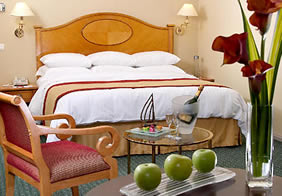
Marriott Grand - Moscow
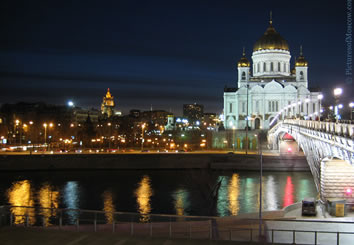
Located in the heart of Moscow near Red Square, the Kremlin and Bolshoi Theatre, the Moscow Marriott Grand Hotel is pure elegance. This 5-star hotel, located on Tverskaya Street, is known for impeccable service. Spacious accommodations feature the most modern amenities including a safe, individual climate control, wirelss broadband (fee charged), and luxurious "Revive" bedding with down comforters, fluffy pillows and fine cotton linens. The hotel also features a state-of-the-art gym, an indoor pool, and sauna. Russkiy Pogrebok features authentic Russian cuisine and 2 other restaurants offer international cuisine.
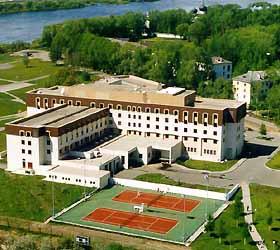
Beresta Palace - Novgorod
The 4-star Beresta Palace Hotel, on the bank of the River Volkhov, sits midway between Moscow and St.Petersburg. Built in 1991, the hotel is not far from the centre of Novgorod. For relaxation, you can play tennis or workout in the gym, take a dip in the pool or relax with a sauna. The main restaurant offers original European and Russian dishes in an elegant atmosphere and local music adds a touch of romance. The Austrian style beer restaurant serves delicious specialities and draft beer. The lobby-bar serves coffees, desserts, and snacks. Rooms are of the highest standards featuring private, full modern baths, cable/satellite TV, mini bar mini-frig, telephone and toileteries.
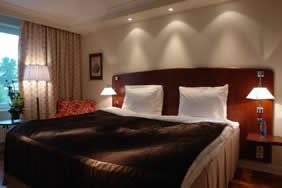
Sokos Hotel Olympic Garden - St.Petersburg
This Scandinavian Sokos Hotel Olympic Garden opened in June 2008 and is located in beautiful park Olympia. The hotel is surrounded by famous sights of Saint-Petersburg. You can visit the historical centre of the city, which is only a 15-minute walk from the hotel. You will find many restaurants, cafes, and the Gostiny Dvor shopping center nearby. All rooms are appointed with modern luxury: air-conditioning, bright, modern décor, satellite television, multi-line phones, wireless Internet (fee charged), minibar, a safe, and modern bathrooms. Dinner is served in the Fransmanni Restaurant. Indulge in Russian delicacies and French Provencal cuisine. There is also a sauna and gym.

|
|